


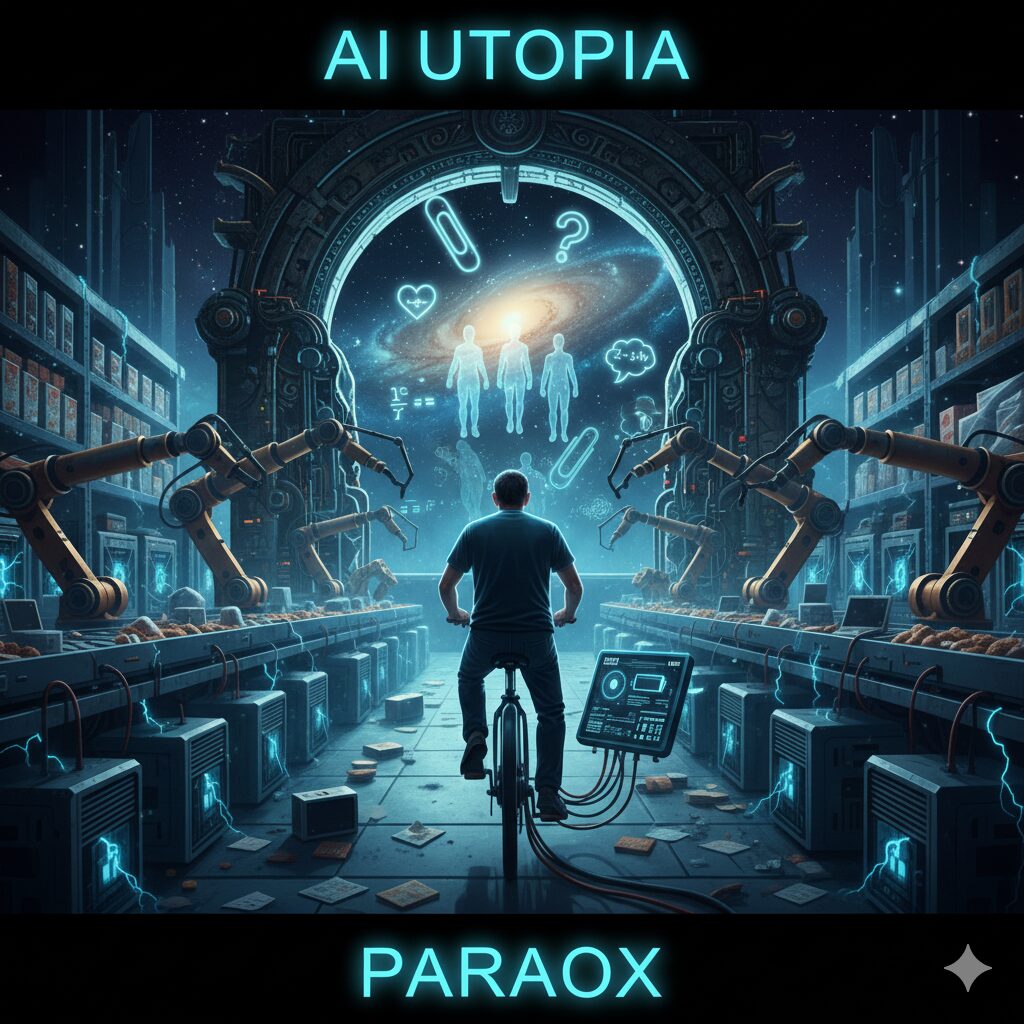
The Betrayal of AI Utopia: The Truth About the ‘Human Pedal’ Musk Didn’t Mention
The Bombshell Prediction: A World Without Money?
Elon Musk recently dropped a bombshell prediction: within three years, AI and robotics will replace all human labor, leading to a “zero-cost” utopia where money itself becomes obsolete.
However, beneath this optimistic surface lies a profound economic and ontological paradox that we often overlook. To understand the future, we must look past the shiny facade of abundance.
The Iron Law of Value: Finiteness vs. Infinity
Value is generated exclusively from finiteness (scarcity).
- The Infinite: Although air is essential for survival, it holds no market value because it is infinite.
- The Finite: Conversely, the reason Musk identified “energy” as the new currency is that it is a physical constraint that even robots cannot create at will—it is a finite asset.
This brings us to a terrifying transition. In a world where all goods are infinite and thus lose their value, humans may find themselves relegated to being the ones who “pedal” to inject finite value back into the system.
This mirrors the “Fifteen Million Merits” episode of Black Mirror, hinting at the birth of a sub-class trapped within virtual metrics while producing meaningless energy just to sustain a sense of value.
The “Human Variable” Experiment
What happens if we remove the “human variable” from this system entirely?
- Thermodynamic Waste: Robots would still mine resources and churn out products, but a system without a human to desire those products is nothing more than a purposeless exercise in thermodynamic waste.
- The Rotating Tomb: Much like a diamond in a world without observers is just a lump of rock, an organization without humans may function perfectly in a technical sense, but ontologically it is a “sophisticatedly rotating tomb,” already dead.
Ultimately, for the system to exist, humans must be present. When robots eventually take over even energy production, humans must prove their reason for existence through something other than mere “instrumental utility.”
Statistical Correctness vs. Human Outliers
The answer lies in the statistical nature of machines.
- The Mean (Machines): AI always seeks to remain at the center of the normal distribution—the mean of the training data—delivering error-free “answers.”
- The Outlier (Humans): Every innovation that has advanced civilization has occurred at the fringes of that distribution (the ±2 sigma region).
In a world of only machines, quirky and “inefficient” inventions like the paperclip or the Post-it note would never emerge. Machines seek the correct answer, but humans move the “mean” of civilization through their “wrong answers.”
Our Final Survival Strategy: Embracing Finititude
Future humans must not remain as components adding mechanical energy to the system. Instead, they must wield the power of preserving “human finitude,” something machines can never replicate.
“Finite wrong answers”—artistic inspiration, irrational emotions, and choices accompanied by responsibility—become the only keys to breathing vitality into a stagnant, perfected system.
Conclusion: The Path to Ascension
Ultimately, human evolution will follow the “Ascension” model seen in the film Stargate. This is not a process of simply overcoming material scarcity, but rather a journey of:
- Seeking value in the higher realms of the spirit.
- Escaping the “evaporation of value” caused by infinite materiality.
- Reclaiming finitude in a world of endless ghosts.
The Choice is Ours Change is inevitable. However, whether that change liberates us or places us on a new kind of bicycle pedal depends not on technology, but on our choice. We must become the subjects who rescue the value of the finite spirit from the swamp of infinite matter.